
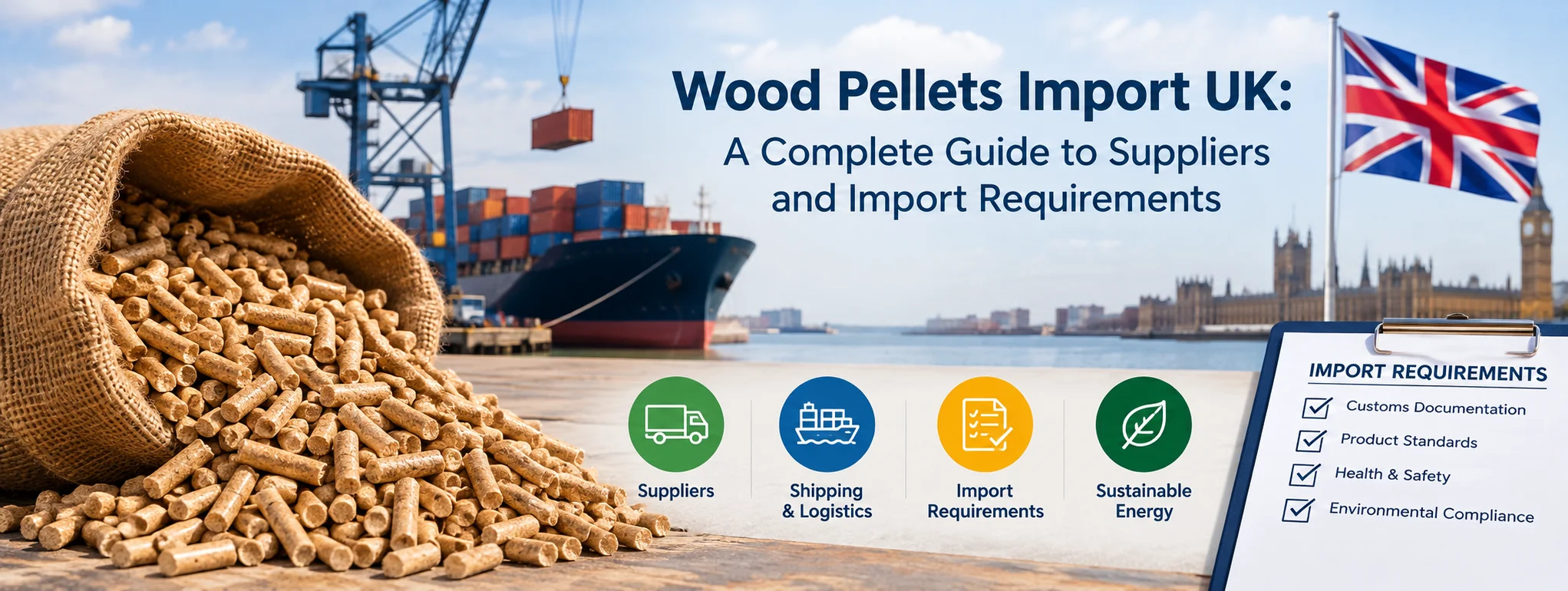
The wood pellets import UK market connects international biomass producers with power generators, heating suppliers, industrial facilities, and residential customers. For businesses in the United States considering exports to Britain, understanding product quality, shipping arrangements, sustainability standards, and customs procedures is essential before negotiating a supply agreement.
Wood pellets are small, compressed cylinders made from materials such as sawdust, wood shavings, and other suitable woody biomass. They are used for heat generation and, in some cases, electricity production. The UK market includes large-volume industrial buyers as well as distributors serving homes and commercial buildings.
However, importing wood pellets successfully requires more than finding a competitive supplier. Buyers must evaluate fuel performance, transportation costs, documentation, and the requirements that apply to their particular shipment. This guide explains the main considerations and highlights practical steps that can help importers make better purchasing decisions.
Understanding the UK Wood Pellets Import Market
The UK sources wood pellets internationally to support different energy applications. Industrial power generation can require large, consistent shipments, while residential heating businesses generally purchase smaller quantities through distributors and retailers.
For American exporters, the UK can be a potential destination for wood pellets produced from qualifying forestry and wood-processing materials. The commercial opportunity depends on the buyer’s specifications, delivered price, supply reliability, and applicable sustainability requirements.
It is important to distinguish between industrial and heating-grade pellets. A product suitable for a large biomass facility may not meet the requirements of a domestic pellet stove. Importers should identify their intended market before requesting quotations.
Who Buys Imported Wood Pellets?
Several types of businesses may purchase imported pellets:
- Energy producers: Facilities that use biomass for electricity generation or combined heat and power.
- Heating fuel distributors: Businesses supplying pellets to residential and commercial customers.
- Industrial users: Operations that use biomass in compatible heating or production systems.
- Wholesale merchants: Companies purchasing bulk quantities for resale to regional suppliers.
- Specialist fuel retailers: Businesses selling certified pellets in bags or smaller deliveries.
Each buyer may have different requirements for pellet dimensions, moisture, ash content, packaging, delivery schedules, and sustainability evidence.
Where Do UK Wood Pellet Imports Come From?
Wood pellets can be produced in several regions, including North America and Europe. The most appropriate source depends on production capacity, freight routes, available certification, and the buyer’s commercial needs.
For US suppliers, proximity to export ports and access to suitable shipping services can influence competitiveness. Nevertheless, a lower factory price does not automatically produce a lower delivered cost.
Importers should compare suppliers using the same delivery terms, product specifications, and shipment quantities. They should also examine whether the producer can maintain consistent quality across multiple orders rather than simply offering an attractive price for one shipment.
Why Supplier Reliability Matters
Biomass buyers often need predictable deliveries to maintain inventory and meet heating or energy requirements. A supplier that cannot deliver the agreed quantity on time may create additional storage, transport, or operational expenses.
Before committing to a long-term contract, request information about production capacity, previous export experience, quality-control procedures, and contingency plans for supply interruptions.
Wood Pellet Quality Standards and Product Specifications
Quality is one of the most important factors in the wood pellets import UK supply chain. Pellets with unsuitable moisture levels, excessive fines, or high ash content can create handling problems and may perform poorly in equipment designed for a particular fuel grade.
A reliable purchase agreement should specify measurable quality requirements rather than relying on broad descriptions such as premium, clean, or high quality.
Important Wood Pellet Characteristics
Moisture content: Excess moisture can reduce the useful energy available from a given quantity of fuel and affect storage stability.
Ash content: Ash is the non-combustible residue left after burning. Its quantity and composition influence cleaning frequency and equipment maintenance.
Calorific value: This indicates the energy released during combustion. Buyers should confirm whether the supplier reports the value on an as-received or dry basis.
Mechanical durability: Durable pellets are less likely to break apart during handling, reducing unwanted dust and fines.
Pellet dimensions: Diameter and length should match the buyer’s equipment and contractual specifications.
Contamination: Buyers should establish controls against unsuitable additives, foreign materials, and inconsistent raw materials.
Comparing Industrial and Heating Pellets
| Feature | Industrial wood pellets | Residential heating pellets |
|---|---|---|
| Primary application | Large-scale energy and industrial heat | Domestic and small commercial heating |
| Typical purchasing format | Bulk shipments | Bags, pallets, or bulk deliveries |
| Main purchasing priorities | Volume, consistency, delivered cost, sustainability | Appliance compatibility, cleanliness, reliable heat |
| Quality assessment | Contract-specific technical specifications | Relevant fuel-grade standards and appliance requirements |
| Delivery planning | Port, terminal, storage, and bulk transport | Warehousing, distribution, and last-mile delivery |
These are general market distinctions, not universal specifications. Buyers must confirm the exact requirements of their intended application.
Wood Pellets Import UK: Customs and Documentation Requirements
Import procedures depend on the product classification, country of origin, destination, and transport arrangements. Businesses importing into Great Britain should check the applicable customs requirements before shipping. Official UK guidance explains the import declaration process and the need for an appropriate GB Economic Operators Registration and Identification number for relevant importers.
Wood pellets are processed products, so importers should not automatically assume that rules for raw timber or firewood apply identically. Confirm the precise commodity classification and any product-specific controls with a customs broker or the relevant UK authority.
Essential Import Documents
The following documents are commonly important in international freight transactions, although the exact requirements vary by shipment:
- Commercial invoice: Records the seller, buyer, goods, quantities, and agreed transaction value.
- Packing list: Describes the shipment’s packaging, weights, and quantities.
- Bill of lading: Provides key information about the sea-freight shipment and its transport arrangements.
- Customs declaration information: Supports the import entry and applicable commodity classification.
- Certificate of origin, where required: Helps establish the origin of the goods when relevant to the transaction or customs treatment.
- Product quality documentation: Provides test results and evidence that the pellets meet contractual specifications.
- Sustainability records, where applicable: Demonstrate compliance with the buyer’s procurement policy or relevant regulatory scheme.
Not every shipment requires every document listed above. The importer should establish the complete document checklist before the cargo leaves the exporting country.
Do Wood Pellets Need Plant Health Documents?
Do not assume that every wood-based product is subject to the same plant health controls. UK guidance on regulated timber, wood products, and bark sets out requirements for relevant materials, including circumstances involving phytosanitary certificates and inspections.
Because finished wood pellets differ from raw timber, confirm their classification and treatment under the rules applicable to the specific consignment. Also check the requirements for solid wood pallets or other packaging, which may be subject to separate international treatment and marking standards.
Official guidance is available through the UK government’s import and customs information at GOV.UK.
Understanding the Total Cost of Importing Wood Pellets
The purchase price is only one part of the total cost. Importers should calculate the expected landed cost before accepting a quotation, particularly when comparing suppliers from different countries.
A useful calculation includes the product price, inland transportation, export handling, ocean freight, insurance, port charges, customs-related costs, and delivery to the final destination. Applicable duties, taxes, storage fees, and inspection charges should also be considered.
Factors That Influence Delivered Prices
Several variables can change the economics of a shipment:
- Shipment size and the efficiency of loading and unloading.
- Distance between the production facility and the export port.
- Ocean freight rates and available vessel capacity.
- Packaging choice, such as bulk cargo or bagged pellets.
- Port congestion, demurrage, and temporary storage.
- Product certification and testing costs.
- Inland transport from the UK arrival port to the buyer’s warehouse.
Rather than relying on a supplier’s headline price, request a written quotation that identifies what is included and excluded. This makes it easier to compare offers and identify unexpected expenses before signing a contract.
Sustainability and Responsible Biomass Sourcing
Sustainability is an important consideration in the international biomass trade, especially for buyers supplying regulated energy markets or organizations with formal environmental procurement policies.
Importers should ask suppliers to explain where the wood originates, how the feedstock is sourced, what certification applies, and whether the documentation covers the actual product and supply chain being purchased.
Certification alone should not be treated as a guarantee that every environmental question has been resolved. Buyers should assess the relevant scheme, chain-of-custody evidence, and any additional requirements attached to their intended use.
For example, UK government guidance on the Timber Procurement Policy describes ways to demonstrate timber legality and sustainability. Separate biomass sustainability requirements may apply to particular energy-support schemes or contracts.
Questions to Ask About Sustainability
Before approving a supplier, ask:
- Can the producer identify the origin of the raw material?
- Which certification scheme, if any, covers the pellets?
- Can the supplier provide current supporting documentation?
- Does the evidence cover the relevant production site and supply chain?
- Are additional emissions or sustainability criteria required by the end customer?
These questions can help buyers avoid documentation gaps and make more informed procurement decisions.
How to Choose a Reliable Wood Pellet Import Supplier
A good supplier should provide consistent product quality, clear commercial terms, and documentation that can be checked before dispatch. Price matters, but it should not be the only selection criterion.
Start by requesting a technical specification sheet and a recent laboratory analysis. Confirm the production capacity, minimum order quantity, packaging format, shipment schedule, and payment terms.
For larger purchases, consider arranging an independent inspection or sampling procedure. Agree in advance on how samples will be collected, which laboratory methods will be used, and what happens if the cargo fails to meet the contract.
Practical Supplier Evaluation Checklist
- Verify the supplier’s legal business identity and export experience.
- Obtain a detailed specification sheet and representative test results.
- Confirm product origin and relevant sustainability documentation.
- Compare complete delivered-cost quotations rather than product prices alone.
- Establish written procedures for delays, quality disputes, and rejected cargo.
A small initial order may help assess a supplier before a longer-term commitment, provided the trial shipment is commercially practical and representative of future deliveries.
Common Challenges in the UK Wood Pellets Import Trade
Even a well-planned shipment can face challenges. Poorly defined specifications may lead to disputes when the cargo arrives. Incomplete paperwork can delay customs processing, while freight disruption can increase the cost of delivery.
Storage is another important consideration. Wood pellets should be protected from moisture and managed to reduce contamination and excessive breakage. Buyers should also ensure that the storage facility and handling procedures are appropriate for the quantity and form of fuel being received.
Long-term contracts require additional attention. Market conditions, freight costs, exchange rates, and production availability can change during the contract period. Clearly defined pricing mechanisms and delivery obligations can reduce uncertainty for both parties.
Final Thoughts
The wood pellets import UK market offers opportunities for qualified suppliers and buyers, but successful trade depends on careful preparation. Businesses need to understand their target market, select the right pellet grade, verify supplier reliability, calculate the full delivered cost, and confirm all applicable import requirements.
For US exporters, the strongest commercial approach is to provide transparent specifications, dependable supply arrangements, and verifiable documentation. For UK buyers, comparing suppliers on quality, total cost, delivery performance, and sustainability evidence can support better purchasing decisions.
Before placing an order, confirm the commodity classification, customs paperwork, contractual quality limits, and any relevant sustainability requirements with the appropriate authorities or professional advisers. These checks can prevent costly surprises and create a stronger foundation for repeat business.
Frequently Asked Questions
1. Why does the UK import wood pellets?
Wood pellets are imported for applications that include biomass electricity generation, industrial heat, and residential or commercial heating.
2. Can US companies export wood pellets to the UK?
US companies can explore the UK market, subject to applicable import rules, buyer specifications, commercial arrangements, and any relevant sustainability requirements.
3. What documents are needed to import wood pellets?
Common documents include a commercial invoice, packing list, shipping document, and customs declaration information. Additional documents depend on the shipment and applicable rules.
4. How can importers compare wood pellet suppliers?
Compare product specifications, independent test results, origin documentation, delivered costs, shipping schedules, and the supplier’s ability to maintain consistent quality.
5. Are all imported wood pellets suitable for home heating?
No. Pellets must meet the requirements of the intended appliance and fuel grade. Industrial pellets should not automatically be assumed suitable for domestic stoves.