
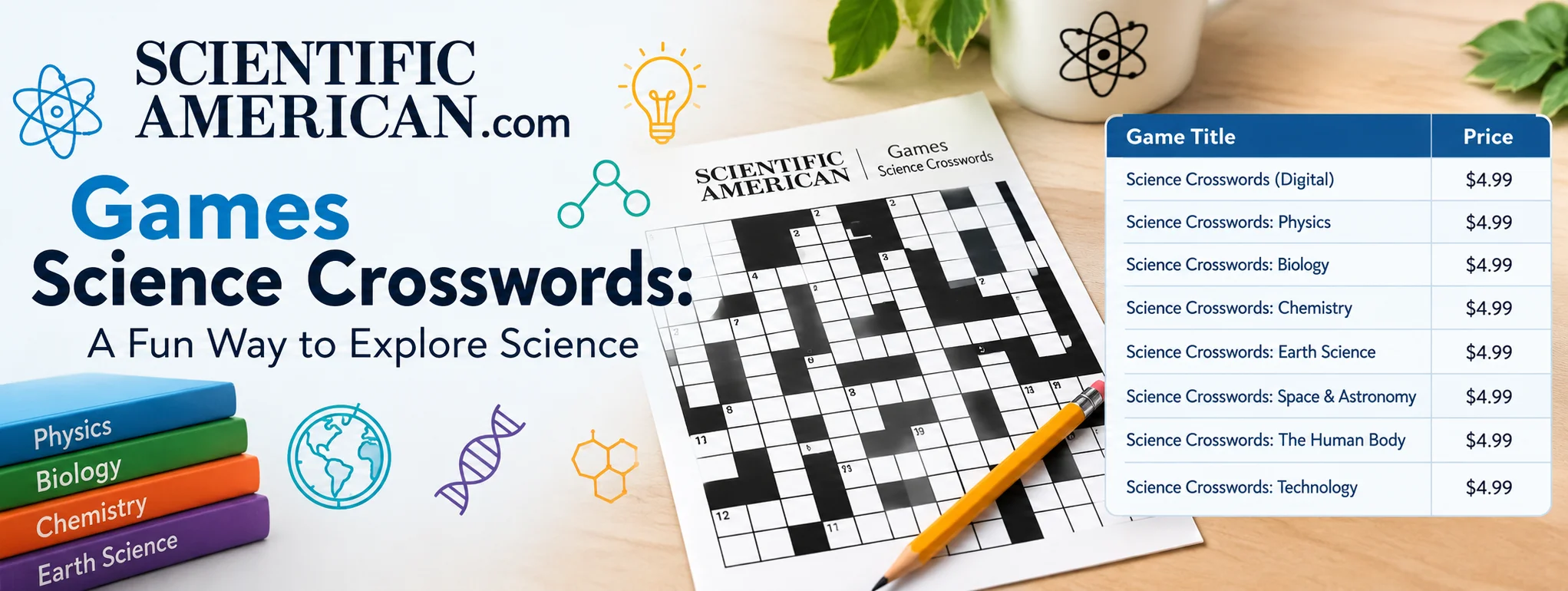
Science becomes more exciting when learning feels like solving a mystery. ScientificAmerican com Games Science Crosswords is a search term associated with the idea of exploring science through crossword puzzles and interactive brain games. For readers who enjoy scientific discoveries, clever clues, and challenging questions, science crosswords can offer an engaging way to learn new facts while keeping the mind active.
Crossword puzzles combine curiosity, vocabulary, reasoning, and problem-solving in one enjoyable activity. Instead of simply reading about physics, biology, chemistry, or astronomy, players must recall information and connect scientific concepts to carefully written clues. This approach can make complex subjects feel more approachable for students, teachers, lifelong learners, and anyone who enjoys a mental challenge.
Scientific American is known for communicating science to a broad audience. Its name is therefore a natural starting point for readers searching for science-related puzzles and educational games. However, the availability and current location of any specific crossword should be checked on the publication’s official website rather than assumed from a search phrase alone.
What Makes ScientificAmerican com Games Science Crosswords Interesting?
Science crosswords bring together two activities that people often enjoy for different reasons: discovering facts and solving puzzles. A traditional article explains a concept, while a crossword encourages readers to retrieve information, recognize patterns, and test what they understand.
The appeal of ScientificAmerican com Games Science Crosswords lies in this combination of entertainment and intellectual exploration. A clue might refer to a planet, a chemical element, a biological process, or a scientist’s contribution. Finding the answer requires more than filling an empty square; it encourages players to connect a word with its meaning.
For example, a clue about the force that keeps planets in orbit may lead to the answer gravity. A clue describing the basic unit of life may point to cell. These short challenges can prompt readers to revisit scientific ideas and discover where their knowledge needs improvement.
Science and Entertainment in One Activity
Educational games can make learning feel less formal. Players are free to experiment with possible answers, correct mistakes, and approach unfamiliar subjects without the pressure of a traditional examination.
This flexibility is especially useful when a puzzle includes a topic that initially seems difficult. A chemistry clue may introduce an unfamiliar term, while an astronomy question may encourage someone to learn more about distant galaxies.
The result is an entertaining activity with genuine educational potential. Although crosswords cannot replace detailed scientific instruction, they can complement reading, classroom lessons, and independent research.
A Challenge for Curious Minds
Crosswords reward patience and attention to detail. A player may recognize a scientific term immediately, while another clue may require several attempts before the correct answer becomes clear.
This process encourages flexible thinking. When one answer does not fit, the player can examine intersecting words, reconsider the clue, and search for a more suitable explanation. Each correction becomes an opportunity to strengthen understanding.
How Science Crossword Puzzles Work
A science crossword generally follows the same basic structure as a conventional crossword. Players receive clues and enter corresponding words into a grid of horizontal and vertical squares. Correct answers intersect, allowing one word to provide useful letters for another.
The difference is the subject matter. Instead of focusing mainly on everyday expressions, names, or general knowledge, a science crossword emphasizes scientific vocabulary, concepts, discoveries, and terminology.
Understanding Scientific Clues
Scientific clues can be direct, descriptive, or based on a concept rather than a definition. Recognizing the type of clue helps players narrow down the possible answers.
Consider these illustrative examples:
- Biology: The process through which plants use sunlight to make food — photosynthesis.
- Astronomy: The star at the center of our solar system — Sun.
- Chemistry: The smallest unit of an element that retains its chemical identity — atom.
- Physics: The measure of how quickly velocity changes — acceleration.
- Earth science: Molten rock beneath Earth’s surface — magma.
These examples demonstrate how crossword clues turn scientific knowledge into short, manageable questions. They are illustrative examples, not claims about the wording of a particular Scientific American puzzle.
Using Intersecting Letters
Crossword grids offer an important advantage: answers support one another. If a player is uncertain about a term, letters supplied by completed words may reveal the correct solution.
For instance, a five-letter answer about a planet could become easier to identify when the second and fourth letters are already available. Rather than guessing randomly, players can compare the remaining possibilities with the clue.
This method encourages logical reasoning and helps readers become more comfortable with unfamiliar vocabulary.
Exploring Science Topics Through Crosswords
One of the most valuable features of science-themed puzzles is their potential variety. Science covers many disciplines, so crossword activities can introduce players to subjects they already enjoy while exposing them to new areas of knowledge.
Biology and the Living World
Biology-related puzzles may cover cells, genetics, ecosystems, evolution, microorganisms, and the human body. Such clues can reinforce essential vocabulary and encourage players to explore how living organisms function.
A puzzle might ask about the molecule that carries genetic information or the process by which cells divide. Even when a player knows the answer, recalling it in a different context can make the term more memorable.
Astronomy and Space Exploration
Astronomy offers an especially rich collection of crossword topics. Planets, moons, stars, galaxies, telescopes, and space missions all provide opportunities for interesting clues.
These puzzles can spark curiosity about the universe. A clue involving a black hole, for example, may encourage a reader to learn how gravity behaves in extreme environments. Another clue might lead to further reading about the formation of stars or the search for planets beyond our solar system.
Chemistry and Physics
Chemistry introduces the language of elements, compounds, reactions, and molecular structures. Physics focuses on matter, energy, motion, waves, electricity, and fundamental forces.
Both subjects contain technical terms that become easier to recognize through repeated exposure. A crossword can help players distinguish related concepts, although more advanced topics may require additional explanations to avoid confusion.
Earth Science and the Environment
Clues about climate, oceans, rocks, earthquakes, weather, and ecosystems can connect scientific learning with everyday life.
For example, understanding the difference between weather and climate can improve how readers interpret environmental reporting. Questions about renewable energy or biodiversity may also encourage people to investigate important issues affecting the planet.
Key Benefits of Playing Science Crosswords
Science crosswords can provide several learning benefits when players approach them as opportunities to understand ideas rather than simply complete a grid.
1. Building Scientific Vocabulary
Scientific fields use precise words to describe processes and observations. Regular exposure to these terms can help players recognize them when reading articles, watching educational videos, or studying textbooks.
2. Practicing Recall and Reasoning
Solving clues requires players to retrieve information from memory. Intersecting answers also encourage them to compare possibilities and evaluate whether a solution fits the available evidence.
3. Encouraging Independent Learning
An unfamiliar clue can become the beginning of a new investigation. Players may consult a reliable reference, read a related article, or explore a subject that they had never considered before.
4. Making Study Sessions More Enjoyable
Short puzzles can add variety to a study routine. Students may find them useful between reading sessions, while adults can use them as a recreational activity that also exercises scientific knowledge.
5. Connecting Different Scientific Ideas
Some clues involve concepts that cross disciplinary boundaries. For example, understanding climate systems can involve chemistry, physics, biology, and Earth science. This can help readers recognize relationships between different areas of knowledge.
ScientificAmerican com Games Science Crosswords: How to Find Relevant Puzzles
Readers searching for ScientificAmerican com Games Science Crosswords should begin by checking Scientific American’s official website and its available games or puzzle sections. Website layouts and offerings can change, so it is important to verify whether a particular crossword is currently available.
Search results may also contain third-party science puzzles, educational games, or older references. These should not automatically be treated as official Scientific American content.
A practical search process can help readers find appropriate activities without wasting time on unrelated pages.
Follow a Simple Search Strategy
- Search for the exact phrase alongside the publication’s name.
- Check whether the result belongs to the official publication or another website.
- Look for a games, puzzles, or interactive content section if one is available.
- Read the instructions to understand whether answers can be checked or hints are provided.
- Confirm that the puzzle is accessible and that its subject and difficulty match your interests.
If no current crossword is available, general science crosswords from reputable educational websites can offer a useful alternative. Check the source’s credibility, especially when a puzzle includes factual explanations or scientific claims.
Choose Reliable Learning Resources
A crossword can contain an ambiguous clue or an outdated explanation. When an answer seems questionable, compare it with a trustworthy scientific reference, educational textbook, or authoritative research organization.
This habit is valuable because scientific knowledge develops over time. A good learning experience should encourage both curiosity and careful verification.
Tips for Solving Science Crosswords More Effectively
A systematic approach can make puzzles easier and more rewarding. Rather than attempting every difficult clue immediately, start with the answers you recognize and gradually use them to uncover the rest of the grid.
- Begin with familiar terms: Fill in straightforward answers before tackling difficult scientific concepts.
- Pay attention to clue wording: Singular and plural forms, abbreviations, and word lengths can narrow down possible answers.
- Use crossing letters: Completed entries provide evidence that can help confirm uncertain solutions.
- Research unfamiliar concepts: Consult a reliable reference when a clue introduces a term you do not understand.
- Review your mistakes: Learn why an answer is correct instead of memorizing the word alone.
It is also helpful to avoid rushing. A difficult puzzle may require time, reflection, and a willingness to reconsider an initial assumption. The goal is not only to finish the grid but also to gain a clearer understanding of the science behind the clues.
Science Crosswords for Students, Teachers, and Adults
Science-themed puzzles can serve different purposes depending on the person using them.
For Students
Students can use crosswords to review terminology before a test or reinforce information after a lesson. Teachers may also create subject-specific grids covering topics such as the solar system, ecosystems, human anatomy, or the periodic table.
The best results come when puzzles supplement explanations, experiments, and other learning activities rather than replace them.
For Teachers and Parents
Educators and parents can use age-appropriate crosswords to introduce scientific language in a relaxed setting. Younger learners may benefit from short clues and familiar subjects, while older students can explore more specialized terminology.
Discussing the answers afterward is particularly useful. A brief explanation can turn a correct guess into meaningful understanding.
For Lifelong Learners
Adults do not need to be science specialists to enjoy scientific puzzles. General-interest crosswords can offer a manageable way to explore new discoveries, refresh forgotten knowledge, and make free time more intellectually engaging.
People who already enjoy science journalism may find puzzles a natural extension of their reading habits.
Science Crosswords Compared With Other Learning Activities
Different educational activities serve different purposes. The following table summarizes how science crosswords compare with several common learning methods.
| Learning activity | Main purpose | Key advantage | Important limitation |
|---|---|---|---|
| Science crosswords | Recall scientific terms and concepts | Interactive and engaging | Limited depth for complex topics |
| Science articles | Explain discoveries and ideas | Provides context and detail | Requires sustained reading |
| Flashcards | Practice definitions and recall | Easy to repeat regularly | May encourage memorization without context |
| Educational videos | Explain ideas visually | Helpful for complex processes | Passive viewing can reduce engagement |
| Practical experiments | Observe scientific principles | Connects theory with evidence | May require equipment and supervision |
Combining these methods can create a stronger learning routine. For example, a reader can complete a crossword, identify an unfamiliar term, read an article about it, and then use flashcards to review the key definition.
The Future of Interactive Science Learning
Digital learning tools continue to create new ways for people to engage with scientific ideas. Online puzzles can potentially include instant feedback, hints, adjustable difficulty, and explanations that appear when a player selects an answer.
These features can make educational games more accessible to different experience levels. Beginners can start with familiar concepts, while experienced players can attempt advanced terminology and more complex clues.
Interactive learning is most effective when it combines convenience with accurate information. A well-designed puzzle should make scientific exploration enjoyable without sacrificing clarity or factual reliability.
For readers interested in Scientific American, the most useful approach is to treat games and puzzles as part of a broader interest in science communication. Reading detailed explanations alongside solving clues provides a more complete understanding than either activity alone.
Final Thoughts
ScientificAmerican com Games Science Crosswords represents an interesting search topic for readers who want to combine scientific curiosity with the challenge of crossword puzzles. Science crosswords can strengthen vocabulary, encourage recall, develop problem-solving habits, and introduce people to fascinating ideas in biology, chemistry, physics, astronomy, and environmental science.
Their greatest value comes from turning a simple clue into an opportunity to investigate something new. Players can begin with familiar answers, use intersecting letters to solve challenging entries, and research unfamiliar concepts to build lasting knowledge.
1 thought on “ScientificAmerican com Games Science Crosswords: A Fun Way to Explore Science”