
Introduction
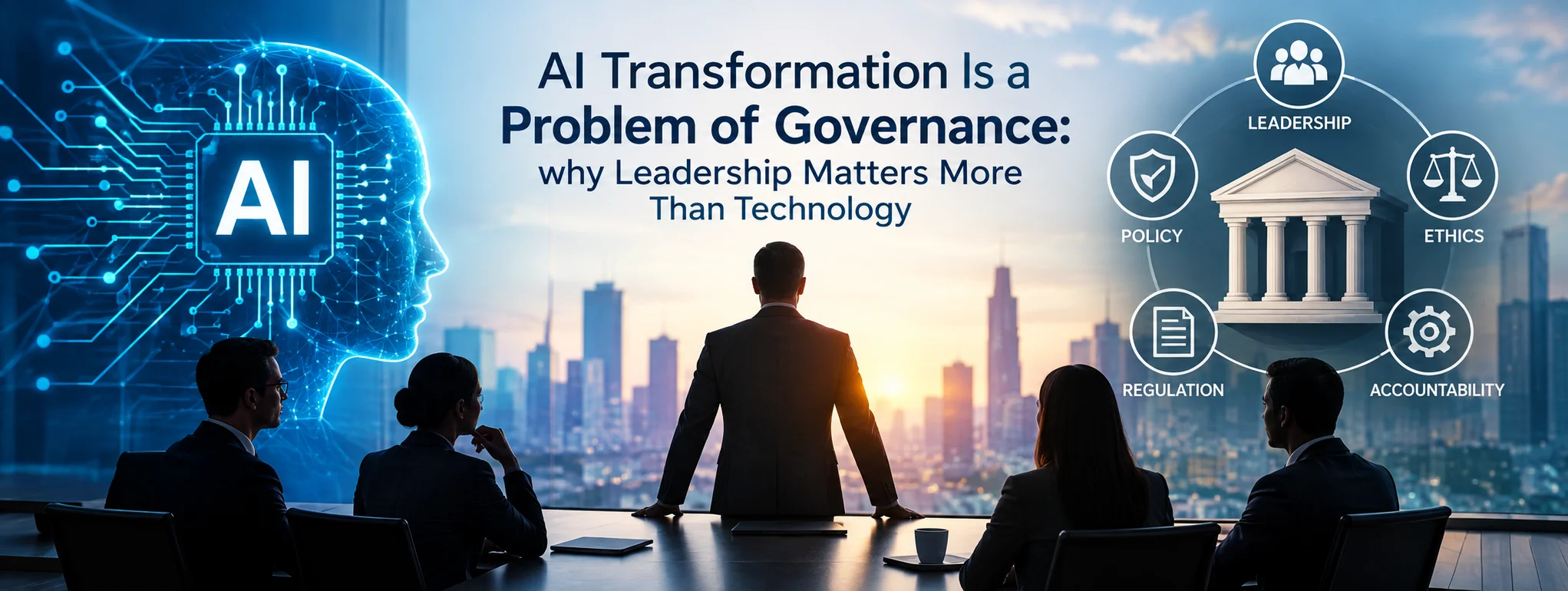
AI Transformation Is a Problem of Governance because successful artificial intelligence adoption depends on much more than powerful software, advanced algorithms, or expensive digital tools. While AI technology can improve productivity, automate repetitive tasks, and support better decisions, organizations need strong leadership, clear policies, and responsible oversight to achieve lasting results. Without these foundations, even the most advanced AI systems can create confusion, security risks, financial losses, and a lack of trust among employees and customers.
Businesses across industries are investing in artificial intelligence to remain competitive in a rapidly changing digital economy. However, buying AI tools does not automatically transform an organization. Leaders must determine why AI is needed, where it should be used, who is responsible for its outcomes, and how its impact will be measured.
The real challenge is building a responsible system in which technology supports business goals rather than creating new problems. Effective governance helps organizations balance innovation with accountability, protect sensitive information, and make confident decisions. When leadership takes responsibility for AI transformation, companies can turn promising technology into meaningful and sustainable business value.
Why AI Transformation Is a Problem of Governance
AI transformation is often treated as a technical project led by IT departments, software developers, or external technology providers. Although these teams play an important role, they cannot independently address every organizational challenge associated with artificial intelligence.
AI influences business strategy, employee responsibilities, customer experiences, data management, and legal obligations. These areas require decisions that extend beyond technical implementation.
Governance establishes the principles, responsibilities, and processes that guide how an organization develops, purchases, deploys, and monitors AI systems. It ensures that innovation remains aligned with company objectives and acceptable standards of risk.
For example, a company might introduce an AI-powered customer service platform to reduce response times. Without proper governance, the system could provide inaccurate information, expose customer data, or make decisions that employees cannot explain. A governance framework identifies these risks before they become serious problems.
This is why AI transformation is fundamentally a leadership responsibility. Technology provides capabilities, but governance determines how those capabilities are used.
Technology Alone Cannot Guarantee Success
Advanced AI systems can analyze large datasets, generate content, and automate complex workflows. However, they do not automatically understand an organization’s values, priorities, or responsibilities.
A technically successful implementation can still fail if employees do not trust the system, managers cannot measure its value, or leadership has not established clear expectations.
Organizations need to answer several essential questions:
- What business problem should AI solve?
- Which decisions can AI make, and which require human approval?
- Who is accountable when an AI-generated result causes harm?
- How will the organization protect confidential information?
- What evidence will demonstrate that the investment is successful?
Answering these questions requires collaboration between executives, technical specialists, legal teams, operational managers, and employees.
The Critical Role of Leadership in AI Transformation
Leadership provides direction and creates the conditions necessary for responsible AI adoption. Executives must move beyond simply approving technology budgets and actively guide how artificial intelligence changes the organization.
Establishing a Clear AI Vision
A successful AI strategy begins with a clear business purpose. Leaders should identify specific challenges that AI can address rather than adopting technology simply because competitors are using it.
For instance, a manufacturing company might use AI to predict equipment failures, while a healthcare organization could explore administrative automation to reduce paperwork. Each initiative requires different safeguards, resources, and success measures.
A strong vision connects AI investments to measurable objectives, such as reducing processing time, improving service quality, or helping employees make better-informed decisions.
When leaders communicate these goals clearly, teams understand why the technology matters and how their work contributes to the wider transformation.
Defining Accountability and Ownership
One of the most significant governance challenges is determining who takes responsibility for AI-related decisions.
If an AI tool produces discriminatory recommendations, inaccurate reports, or misleading information, responsibility should not disappear behind the explanation that the system made the decision.
Organizations should assign clear ownership to business leaders, technical teams, and relevant risk specialists. Each role must understand its authority and obligations.
Leadership should establish escalation procedures for incidents, regular performance reviews, and documented approval processes for high-impact AI applications.
Clear accountability creates confidence because employees know whom to contact when something goes wrong and who has the authority to correct it.
Building a Culture of Responsible Innovation
AI transformation can create excitement, but it may also produce anxiety about job security, changing responsibilities, and unfamiliar workflows.
Effective leaders acknowledge these concerns instead of expecting employees to accept every new system without question. They provide training, explain the reasons behind changes, and invite feedback from the people who use AI tools daily.
A supportive culture encourages experimentation while maintaining sensible boundaries. Employees should be able to report errors, challenge questionable outputs, and suggest improvements without fear of unfair punishment.
This balance makes innovation more practical and helps organizations discover problems before they become expensive failures.
Essential Pillars of Effective AI Governance
A reliable governance framework combines strategic direction with practical controls. The following pillars help organizations establish a foundation for responsible and effective AI adoption.
1. Data Quality and Privacy
AI systems depend on the information used to train, configure, or operate them. Poor-quality data can produce unreliable results, while improperly managed information can expose confidential business or customer details.
Organizations should define which data employees may use with AI tools, how information is stored, and who can access it. They should also assess data quality, retention requirements, and applicable privacy obligations.
Leaders must ensure that privacy protection is part of the planning process rather than an afterthought.
2. Risk Assessment and Human Oversight
Not every AI application carries the same level of risk. Using AI to summarize an internal meeting is different from using it to evaluate job applicants, approve loans, or support medical decisions.
Organizations should classify AI use cases according to their potential impact and establish safeguards proportionate to the risk.
High-impact applications may require human review, independent testing, documented explanations, and formal approval before deployment. Human oversight should be meaningful, allowing qualified people to challenge outputs and intervene when necessary.
3. Transparency and Explainability
Employees, customers, and other stakeholders need appropriate information about how AI influences important decisions.
Complete technical explanations may not be practical for every system, but organizations should communicate the system’s purpose, limitations, and role in decision-making.
Transparency also includes identifying when AI-generated content requires review and documenting significant changes to AI systems.
These practices make it easier to investigate errors, resolve complaints, and maintain public trust.
4. Compliance and Ethical Standards
AI governance must reflect the laws, industry requirements, and ethical expectations that apply to an organization.
Depending on the business and jurisdiction, relevant obligations may concern privacy, intellectual property, discrimination, cybersecurity, consumer protection, and recordkeeping.
Leaders should involve qualified legal and compliance professionals when evaluating sensitive applications. They should also review policies as technology and regulatory expectations evolve.
5. Continuous Monitoring and Improvement
AI governance is not a one-time approval process. Models, datasets, business requirements, and external conditions can change over time.
Organizations should monitor accuracy, reliability, security, user feedback, and unexpected outcomes. When performance deteriorates, responsible teams need the authority to investigate, correct, restrict, or suspend the system.
Continuous monitoring transforms governance from a static policy document into an active management practice.
AI Governance vs. Technology Implementation
The distinction between governance and implementation becomes clearer when their responsibilities are compared.
| Area | Technology Implementation | AI Governance |
|---|---|---|
| Primary focus | Building and deploying AI tools | Ensuring responsible and effective use |
| Main responsibility | Technical teams and developers | Executives, business owners, and oversight teams |
| Decision-making | System configuration and integration | Policies, acceptable risks, and accountability |
| Data management | Processing and technical access | Privacy, permitted use, and data ownership |
| Performance | Speed, accuracy, and reliability | Business value, fairness, and ongoing risk |
| Success measurement | Technical performance indicators | Business outcomes and responsible operation |
Both areas are essential. Strong governance cannot compensate for a poorly engineered system, and excellent engineering cannot replace responsible leadership. Sustainable AI transformation requires these capabilities to work together.
Common Challenges Organizations Face During AI Transformation
Even organizations with substantial resources can struggle to integrate AI into everyday operations. Understanding common obstacles helps leaders develop more realistic strategies.
Unclear Business Objectives
Some businesses adopt AI without identifying a specific problem to solve. This can lead to expensive experiments that generate impressive demonstrations but little practical value.
Leaders should begin with a defined business need and establish measurable outcomes before selecting a tool.
Resistance From Employees
Employees may worry that automation will eliminate their roles or reduce their influence over important decisions. Poor communication can increase these concerns and slow adoption.
Training, transparent communication, and opportunities to participate in implementation help employees understand how AI will affect their work.
Fragmented Decision-Making
Different departments may purchase separate AI tools without coordinating their security requirements, budgets, or data practices. This creates inconsistent standards and makes oversight difficult.
A central governance framework can establish shared policies while allowing departments to pursue appropriate use cases.
Overconfidence in AI Outputs
AI systems can generate convincing answers that contain errors, outdated information, or unsupported conclusions. Treating every output as reliable can create serious operational and reputational problems.
Organizations should define verification requirements and train employees to recognize the limitations of AI-generated information.
Measuring the Wrong Outcomes
Counting AI tools, licenses, or automated tasks does not necessarily demonstrate business success.
Organizations should evaluate whether AI improves meaningful outcomes, including service quality, productivity, decision accuracy, risk reduction, and employee experience.
A Practical Roadmap for Strong AI Governance
Organizations do not need to transform every department simultaneously. A structured, phased approach can make implementation more manageable.
Step 1: Assess Current AI Usage
Identify the AI tools employees already use, including applications purchased by individual departments. Review their purposes, data access, business value, and potential risks.
This assessment reveals gaps that leadership may otherwise overlook.
Step 2: Establish a Governance Team
Create a cross-functional team involving business leadership, IT, cybersecurity, legal or compliance specialists, and relevant operational representatives.
Assign decision-making authority and define responsibilities for approvals, monitoring, and incident response.
Step 3: Develop Clear Policies
Create practical policies covering approved tools, confidential information, human review, accountability, and acceptable use.
Policies should be understandable and accessible. Employees need clear instructions they can follow during everyday work.
Step 4: Start With Controlled Pilot Projects
Select a small number of use cases with clear objectives and manageable risks. Test them in real workflows, collect feedback, and evaluate their performance before expanding.
Pilot projects allow organizations to learn from mistakes without exposing the entire business to unnecessary disruption.
Step 5: Train Employees and Managers
Provide role-specific training on AI capabilities, limitations, privacy, verification, and escalation procedures.
Managers also need guidance on evaluating AI-related business cases and making informed decisions about risk.
Step 6: Measure Results and Improve
Review performance against predefined targets. Examine both benefits and unintended consequences, then update policies and processes as necessary.
A successful governance program evolves alongside the organization instead of remaining fixed after the initial rollout.
Five Key Principles Leaders Should Remember
- Start with strategy: Select AI applications that address genuine business needs.
- Assign clear ownership: Ensure every important AI system has an accountable business owner.
- Protect people and data: Build privacy, security, fairness, and human oversight into implementation.
- Empower employees: Provide training and encourage constructive feedback.
- Measure meaningful results: Evaluate business impact alongside technical performance and risk.
These principles help leaders maintain focus while navigating the complexity of organizational AI transformation.
The Future of AI Transformation Depends on Governance
As AI capabilities expand, organizations will face new opportunities alongside increasingly complex decisions about accountability, security, and trust.
Businesses that treat governance as an obstacle may struggle to scale successful experiments. Those that integrate governance into their strategy can create a more reliable environment for innovation.
This does not mean every AI decision requires excessive paperwork or lengthy approval procedures. Effective governance should be proportionate to risk, practical for employees, and flexible enough to support experimentation.
Leaders should distinguish between low-risk applications that can move quickly and sensitive systems that require deeper review. This approach preserves the speed of innovation without sacrificing responsibility.
Organizations should also prepare for changes in workforce skills and job responsibilities. AI may automate certain tasks while increasing demand for judgment, communication, critical thinking, and technical supervision.
Leadership must therefore treat AI transformation as an organizational change rather than simply a software upgrade. The objective is not to replace human judgment everywhere, but to combine human expertise with machine capabilities in ways that create lasting value.
Frequently Asked Questions
1. Why is AI transformation a governance problem?
AI transformation affects business strategy, accountability, privacy, risk, and employees. Governance ensures these areas are managed responsibly while technology is introduced.
2. Does AI governance slow down innovation?
Not necessarily. Clear policies and predefined approval processes can reduce uncertainty, prevent avoidable mistakes, and help teams innovate with greater confidence.
3. Who is responsible for AI governance?
Executive leadership should provide direction and accountability, supported by technical teams, business owners, legal specialists, cybersecurity professionals, and other relevant stakeholders.
4. Can small businesses benefit from AI governance?
Yes. Small businesses can start with simple policies for approved tools, confidential data, output verification, and employee responsibilities without creating a complex governance department.
5. How can businesses measure successful AI transformation?
Businesses can measure improvements in productivity, service quality, cost efficiency, decision accuracy, customer satisfaction, employee experience, and risk management.
Final Thoughts
AI Transformation Is a Problem of Governance because the long-term value of artificial intelligence depends on the decisions people make around it. Powerful technology can create new opportunities, but without clear leadership, accountability, and responsible oversight, those opportunities can quickly become costly challenges.
Organizations need leaders who can connect AI investments to meaningful objectives, communicate changes effectively, protect sensitive information, and establish practical rules for responsible use. They must also empower employees to learn, question unreliable outputs, and contribute to continuous improvement.
1 thought on “AI Transformation Is a Problem of Governance: Leadership Matters More Than Technology”