
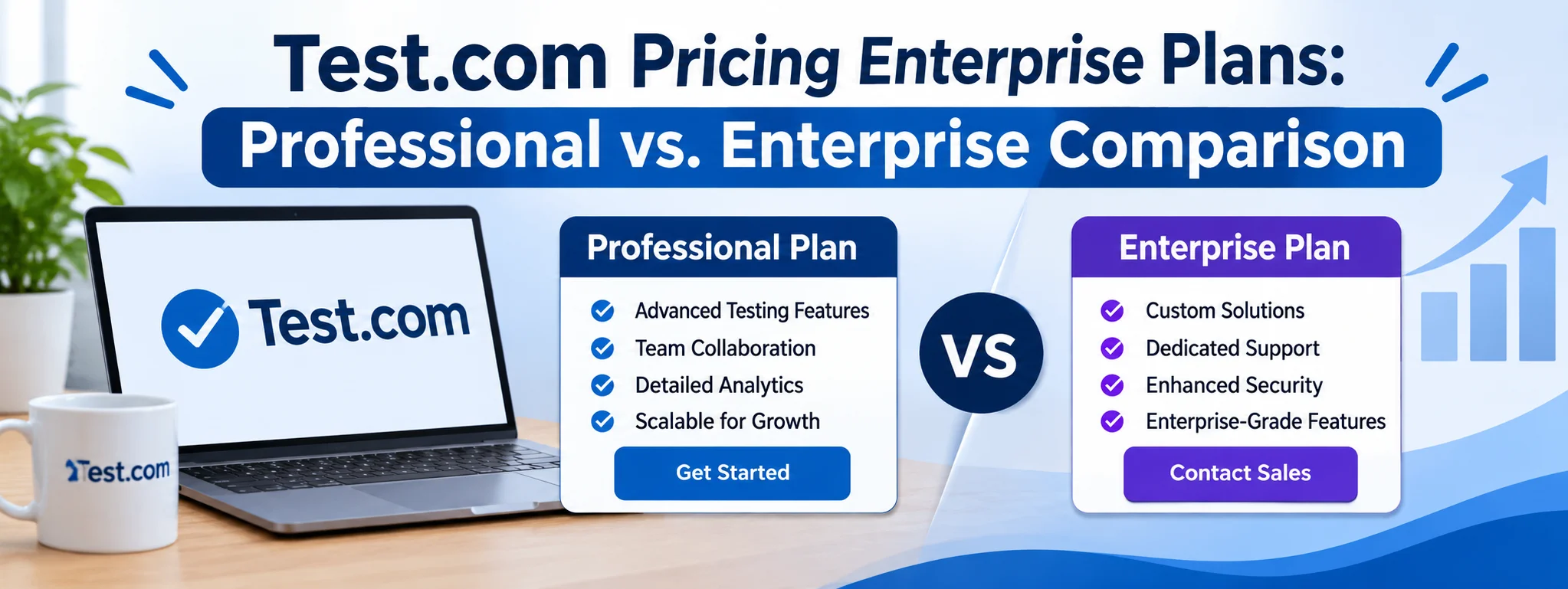
Choosing the right online testing platform requires more than checking its advertised subscription price. Organizations need to understand setup expenses, hosting charges, examination limits, available features, and long-term costs before making a decision. Test.com Pricing Enterprise Plans is an important topic for certification organizations, training providers, educational institutions, and businesses that manage online examinations.
Test.com is associated with Gauge, an online examination and certification platform designed to help organizations create tests, manage candidates, deliver assessments, and handle certification programs. Its Professional and Enterprise plans target different operational requirements. Professional is intended for growing testing programs, while Enterprise is designed for organizations handling larger examination volumes.
Understanding Test.com and Its Gauge Platform
Test.com provides access to Gauge, a platform focused on online examinations, professional assessments, and certification management. Instead of simply creating basic quizzes, organizations can use the platform to manage more structured testing operations.
Its potential applications include:
- Professional certification and licensing examinations.
- Employee training and workplace assessments.
- Educational testing and online learning.
- Industry-specific qualification programs.
- Compliance and professional development examinations.
The platform is particularly relevant to organizations that need a consistent way to deliver assessments and manage examination-related information.
Understanding this distinction is important because its pricing reflects a more comprehensive testing environment than a simple quiz-building subscription.
Test.com Pricing Enterprise Plans: Professional vs. Enterprise
Test.com offers two primary pricing categories: Professional and Enterprise. Their main differences involve starting costs, hosting expenses, setup charges, and the scale of testing operations they are intended to support.
The Professional plan provides a lower-cost starting point for organizations developing their examination programs. Enterprise is positioned for larger operations that require higher testing volumes and more extensive capabilities.
Professional Plan Pricing and Overview
The Professional plan is designed for growing certification programs and organizations that do not necessarily need an enterprise-level arrangement.
Its published starting prices are:
- Software subscription: $750 per year.
- Annual hosting: $250.
- One-time setup: $500.
- Calculated first-year starting cost: approximately $1,500.
After the initial setup charge, the published software and hosting amounts total approximately $1,000 annually, assuming the listed rates remain unchanged.
Professional also has eight usage-based pricing levels. This structure gives organizations room to select a pricing level according to their examination requirements rather than immediately committing to the highest subscription category.
For a smaller certification provider, this can be a practical starting point. However, buyers should confirm the examination allowance for their selected level because the complete volume limits are not clearly established by the headline starting price.
Enterprise Plan Pricing and Overview
The Enterprise plan is intended for organizations with substantial testing requirements, particularly programs delivering more than 10,000 tests annually.
Its published starting charges are:
- Software subscription: $10,000 per year.
- Annual hosting: $1,000.
- One-time setup: $2,000.
- Calculated first-year starting cost: approximately $13,000.
The software and hosting charges together represent approximately $11,000 annually after the initial setup fee, assuming the same published rates continue.
Enterprise also uses volume-based pricing. Its published starting rate is $3 per test, with lower rates available as testing volume increases. The actual amount depends on the organization’s requirements and the agreement offered by the vendor.
This option is more suitable for large certification bodies, established training providers, and businesses that manage continuous examination programs.
Professional vs. Enterprise: Complete Pricing Comparison
The following table summarizes the published starting prices and the calculated first-year expenses.
| Pricing Detail | Professional Plan | Enterprise Plan |
|---|---|---|
| Annual software price | $750 | $10,000 |
| Annual hosting | $250 | $1,000 |
| One-time setup | $500 | $2,000 |
| First-year starting total | $1,500 | $13,000 |
| Software and hosting after setup | $1,000/year | $11,000/year |
| Intended usage | Growing programs | More than 10,000 tests annually |
| Pricing structure | Eight usage-based levels | Volume-based pricing |
| Starting volume rate | Depends on selected level | $3 per test |
Note: First-year and subsequent-year totals are calculated from the published starting charges. They are not guaranteed quotations. Additional modules, examination volume, and other requirements can affect the final amount.
Which Plan Offers Better Value?
The answer depends on the size and complexity of your testing program.
Professional is the more economical starting option for organizations that want advanced examination tools without immediately investing in an enterprise-level subscription.
Enterprise has a higher initial cost, but its expanded capabilities may offer better operational value for organizations managing thousands of candidates and multiple certification programs.
For example, an organization conducting 300 examinations annually may not need the additional infrastructure of Enterprise. However, an organization handling 20,000 examinations, managing digital credentials, and connecting its testing platform to internal business software may benefit from the Enterprise environment.
The important consideration is not simply which plan costs less. It is whether the selected subscription supports your actual workload without creating additional administrative expenses.
Enterprise Features That Make the Difference
The Enterprise plan offers capabilities intended for organizations with more demanding examination and certification requirements.
1. Certification and Digital Badging
Enterprise includes certification and badging capabilities. These tools can help organizations connect examination results with professional credentials and recognition.
Digital badges can make qualifications easier to share and verify, while structured certification processes help administrators manage professional achievements.
2. Proctoring Integration
Examination security becomes increasingly important when tests determine professional qualifications, licenses, or workplace eligibility.
Enterprise lists proctoring integration among its features. Gauge also supports connections with external remote proctoring providers and its GaugeLive option for on-site examinations.
Organizations should confirm which proctoring arrangements are included in their proposed package and whether external session charges apply.
3. Lessons and Learning Management
Enterprise includes lessons as part of its listed feature set. This can help organizations connect learning activities with assessments and certification requirements.
For example, a professional training provider may want candidates to complete learning material before taking a final qualification examination.
This creates a more organized experience than managing training and assessment through completely separate workflows.
4. eCommerce Capabilities
Organizations that sell examination access or training services need a way to manage transactions alongside their testing operations.
Enterprise lists eCommerce capability among its included features. This is particularly relevant to certification providers that accept paid examination registrations.
Before purchasing, confirm payment processing arrangements, transaction costs, supported payment methods, and any additional configuration expenses.
5. Developer Tools and Integrations
Large organizations often use multiple business applications, including learning management systems, customer relationship management software, and internal databases.
Enterprise supports technical integrations through REST API access, webhooks, and single sign-on (SSO).
These capabilities can help reduce manual data entry and create smoother connections between existing systems.
How Enterprise Pricing Works for High-Volume Testing
One of the most important aspects of Test.com Pricing Enterprise Plans is the relationship between annual examination volume and the final subscription cost.
Gauge states that Enterprise volume pricing starts at $3 per test. The rate decreases as examination volume increases, and the company reports that its highest-volume customers pay well below $1 per test.
This approach is useful because organizations do not all have the same testing requirements.
A certification provider delivering 12,000 examinations annually has different operational needs from a national organization administering 100,000 assessments.
Rather than assuming that every customer receives an identical per-test rate, buyers should request a quotation based on their estimated annual volume.
Example of an Enterprise Budget
Consider an organization planning to administer 15,000 examinations during its first year.
At the published starting volume rate of $3 per test, a simple illustration would be:
15,000 × $3 = $45,000.
However, this calculation should not be treated as the organization’s guaranteed subscription price or added automatically to the $10,000 base fee. Gauge describes volume-based Enterprise pricing as a separate pricing approach. Buyers should ask the company how the base charges, volume rates, hosting, and included features interact in their specific quotation.
This distinction prevents inaccurate budgeting and makes the purchasing process more transparent.
Is There a Free Trial for Test.com?
Yes. Gauge advertises a 30-day free trial that does not require a credit card.
This provides an opportunity to explore the platform before committing to an annual subscription.
During the evaluation period, organizations should test more than the basic examination interface. They should also examine administrative workflows, reporting, candidate management, and any integrations that are important to their operations.
A useful trial checklist includes:
- Create a sample examination using the organization’s actual question formats.
- Test candidate registration and the examination experience.
- Review available reporting and analytics.
- Evaluate security settings and administrator permissions.
- Check whether the required integrations and certification workflows meet business needs.
Testing these areas can reveal limitations before the organization invests in implementation.
What Should You Check Before Choosing a Plan?
Published subscription prices provide a useful starting point, but they do not answer every purchasing question.
A careful evaluation should consider the following areas.
Annual Examination Allowances
Ask how many completed tests are covered by the selected Professional pricing level. For Enterprise, provide realistic estimates for the first 12 months and explain any expected growth.
Implementation and Data Migration
Confirm what the setup fee covers. Ask whether existing candidate records, question banks, examination history, and other information can be migrated.
Also establish who is responsible for preparing and checking the imported information.
Security and Compliance Requirements
Organizations handling professional qualifications may have strict security and audit requirements. Check access controls, authentication, reporting records, and the documentation available for your compliance obligations.
Do not assume that purchasing Enterprise automatically satisfies every industry-specific regulatory requirement.
Support and Contract Conditions
Gauge advertises white-glove support across its plans. Nevertheless, buyers should confirm support availability, response expectations, onboarding responsibilities, renewal conditions, and cancellation terms in the written agreement.
Additional Expenses
Ask for a complete breakdown of any costs not included in the advertised starting price, particularly external proctoring services, payment processing, custom development, and optional modules.
Who Should Choose Professional and Who Should Choose Enterprise?
Professional is a sensible option for smaller and developing certification programs. It provides access to testing, user management, security, customization, reporting, and analytics at a substantially lower starting subscription price.
Enterprise is better suited to organizations with larger annual examination volumes and more complex operational requirements. Its additional capabilities can support digital credentials, proctoring integrations, lessons, eCommerce, and developer connections.
A useful purchasing strategy is to begin with a clear estimate of annual examinations, identify the required modules, and compare the full cost of each configuration.
Do not purchase a more expensive plan simply because it has an Enterprise label. Select it when the additional functionality addresses genuine operational requirements.
Final Thoughts
Understanding Test.com Pricing Enterprise Plans makes it easier to select an examination platform that matches your organization’s size, budget, and long-term objectives.
The Professional plan offers a more affordable entry point, with a published software starting price of $750 annually. Enterprise starts at $10,000 annually and targets organizations that require more than 10,000 examinations per year.
Although Enterprise requires a larger investment, its certification management, proctoring integrations, eCommerce capabilities, and developer tools can provide valuable support for complex testing operations.
The smartest approach is to calculate your expected examination volume, identify essential features, and request a detailed quotation before making a final decision. A well-matched platform can improve administrative efficiency, strengthen examination management, and support sustainable growth.
Frequently Asked Questions
1. How much does Test.com Professional cost?
The Professional plan starts at $750 annually, with an additional $250 hosting charge and a $500 one-time setup fee. Its calculated first-year starting cost is approximately $1,500.
2. How much does Test.com Enterprise cost?
Enterprise starts at $10,000 annually, plus $1,000 for hosting and a $2,000 one-time setup fee. The calculated first-year starting cost is approximately $13,000.
3. What is the main difference between Professional and Enterprise?
Professional is intended for growing certification programs, while Enterprise targets large organizations handling more than 10,000 tests annually and needing additional certification, integration, and business capabilities.
4. Does Test.com offer a free trial?
Yes. Gauge advertises a 30-day free trial without requiring a credit card.
5. Is Enterprise pricing based on examination volume?
Yes. Gauge publishes Enterprise volume pricing starting at $3 per test, with lower rates available as annual testing volume increases. The final price depends on the organization’s requirements and agreement.
1 thought on “Test.com Pricing Enterprise Plans: Professional vs. Enterprise Comparison”